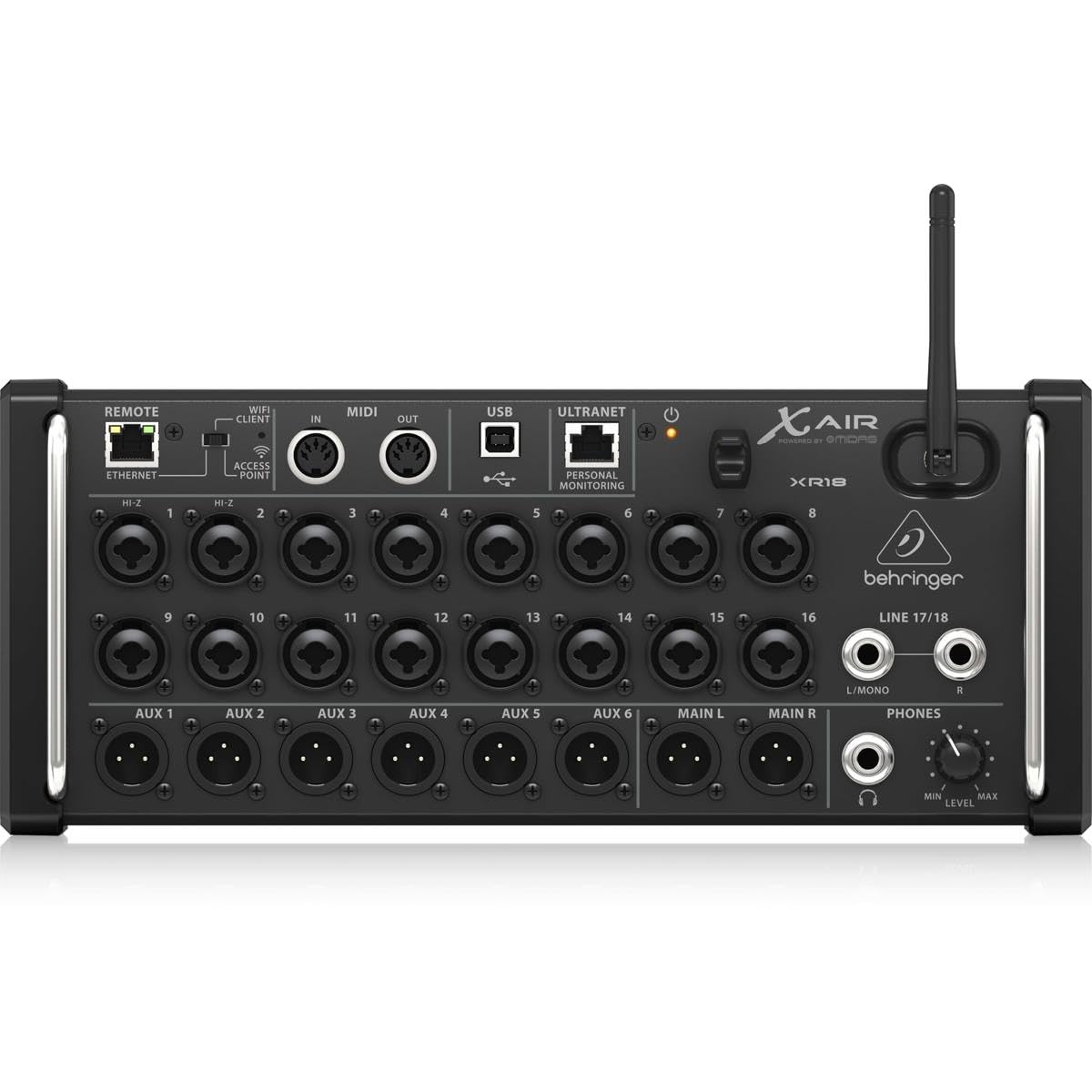
The Behringer X AIR XR18 is a digital mixer that has carved out a notable niche in the live sound and recording world. It’s an 18-channel, 12-bus unit designed to be controlled entirely via iPad or Android tablets, and it includes 16 programmable Midas preamps, an integrated Wi-Fi module, and a multi-channel USB audio interface. At its core, the XR18 aims to deliver professional-grade mixing in a rack-mountable, portable form factor, but how it performs in real-world scenarios is worth examining closely.
In practice, the XR18 is often found in small to mid-sized venues, houses of worship, rehearsal spaces, and for live streaming setups. Its rack-mountable design (1U height) makes it easy to integrate into existing gear racks or to transport in a flight case. The lack of physical faders and knobs on the unit itself is a deliberate trade-off—everything is controlled via a tablet or smartphone app. This means you need to have a tablet dedicated to mixing, and the Wi-Fi connection becomes a critical point of reliability. Many users report that the built-in Wi-Fi module works adequately for smaller spaces, but for larger venues or situations requiring rock-solid stability, an external router is often recommended. This is a limitation worth noting: the integrated Wi-Fi can be finicky, especially in environments with heavy wireless interference.
Key functional features include the 16 Midas-designed programmable preamps, which are the same preamps found in more expensive Midas consoles. They offer clean gain, low noise, and a decent amount of headroom, making them suitable for both dynamic and condenser microphones. The mixer provides 8 XLR outputs, 2 aux sends, and a stereo headphone output, alongside the USB audio interface that allows for 18×18 channel recording and playback with a computer. The built-in effects processing includes reverb, delay, compression, and EQ, all of which are serviceable for live sound but not as deep as dedicated outboard gear. The XR18 also supports 40-band EQs on each channel and bus, which is a lot of flexibility for shaping sound.
One trade-off to consider is the learning curve associated with the tablet-based interface. While the X AIR app (available for iOS and Android) is generally well-designed, mixing on a touchscreen can feel less intuitive than using physical faders, especially during fast-paced live shows where you need to make quick adjustments. The app’s layout is logical, but it requires a certain level of familiarity to navigate efficiently. Additionally, the mixer lacks built-in Bluetooth for audio streaming, which some users might miss for background music or intermission playback—though you can work around this by connecting a device via the USB interface or using an external Bluetooth receiver.
Compared to a traditional analog mixer like the Mackie 1604 or Yamaha MG series, the XR18 offers far more routing flexibility, recallable scenes, and built-in effects. Analog mixers are simpler to operate without a screen, but they lack the ability to save and recall settings, which is a huge advantage for the XR18 in scenarios where you have multiple bands or events. On the other hand, compared to a higher-end digital mixer like the Allen & Heath SQ-5 or Yamaha TF series, the XR18 feels more limited in terms of processing power and build quality. The XR18’s plastic chassis is lighter but less rugged, and the preamps, while good, aren’t quite at the level of the top-tier offerings. It sits comfortably in a middle ground—more capable than an analog board but less polished than premium digital consoles.
Who is the XR18 suitable for? It’s a good fit for musicians or sound engineers who need a portable, affordable digital mixer for small tours, rehearsal spaces, or fixed installations where space is tight. It works well for podcasters or streamers who want multi-channel recording and control from a tablet. It’s also a solid choice for houses of worship or community theaters with moderate sound requirements. However, it’s not ideal for those who prefer tactile faders and knobs for hands-on mixing, or for large-scale events where absolute reliability and redundancy are critical. The reliance on Wi-Fi and a tablet can be a dealbreaker for some, and the lack of physical controls may frustrate users accustomed to analog workflows.
Overall, the Behringer X AIR XR18 delivers on its promise of a compact, feature-rich digital mixer at a price point that undercuts many competitors. It has its quirks—the Wi-Fi stability, the learning curve, and the plastic build—but for many use cases, it offers a lot of functionality in a small package. Just go in knowing that you’ll likely need a dedicated tablet and possibly an external router to get the most out of it.