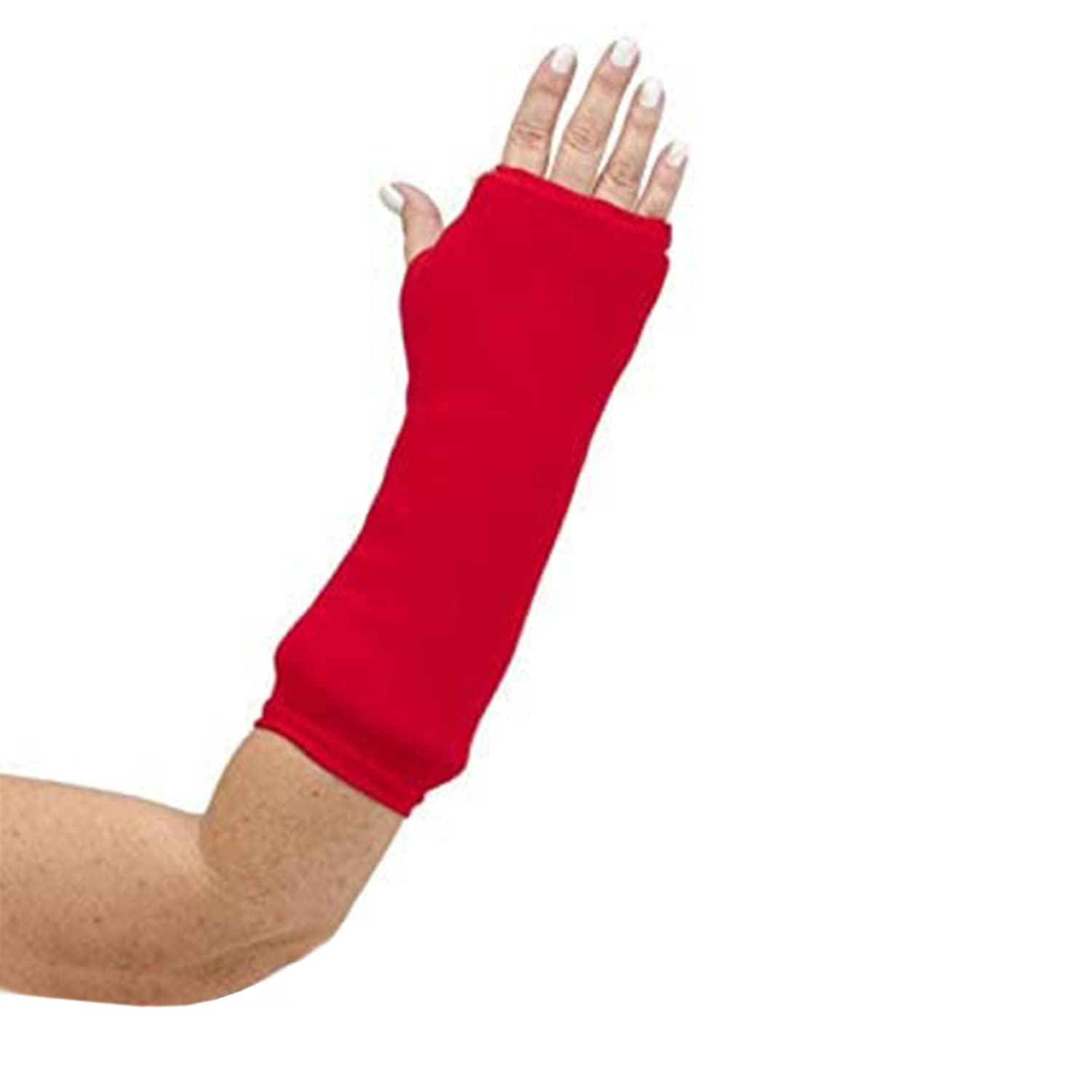
Arm casts are awkward in ways that go beyond the inconvenience of a broken bone. They snag on sleeves, collect crumbs, and turn a quick shower into a logistical project. CastCoverz! Armz! is one of several products aimed at that problem: a fabric sleeve that slides over a forearm cast to protect clothing and skin from the rough fiberglass or plaster surface. This review looks at the large Real Red version, made in the USA, and what it realistically does and does not solve.
The core idea is simple. Armz! is a stretchy fabric tube, open at both ends, sized to fit over a cast on the forearm or lower arm. The large size is intended for bigger arms or bulkier casts, and the Real Red color is a solid, saturated red rather than a pastel or print. Because it is fabric rather than plastic, it is breathable and soft against the skin at the cast edges, which is where most irritation tends to happen. It is not waterproof, and the manufacturer does not position it as such — this is a comfort and clothing-protection accessory, not a shower shield.
In daily use, the cover goes on much like a wide sock. You pull it over the cast, position the openings at the wrist and upper arm, and it stays put through normal activity. The main practical benefit is that it creates a smooth layer between the cast’s rough exterior and long sleeves, so sweaters and jackets go on without catching. It also keeps lint, pet hair, and food debris off the cast surface, which matters over the four to eight weeks a typical arm cast stays on. For people who work at a desk or in a job where sleeves are expected, the cover makes the cast less conspicuous and less abrasive to clothing.
Several features are worth noting factually. The fabric is a stretch blend that accommodates some variation in cast shape, and the open-ended design means it does not interfere with fingers or the elbow. The large size runs generously; users with slim forearms may find it loose, and a smaller size would likely fit better. Because it is machine washable, it can be rotated with a second cover, which is more practical than it sounds — a single cover worn daily for weeks will pick up odor and grime, and having only one means washing it while the cast is exposed.
The clearest limitation is that Armz! does nothing for water protection. If you need to shower or swim, you still need a dedicated waterproof cast cover — a plastic or rubber sleeve with a sealed cuff, which is a different product category entirely. Those tend to be bulkier, less comfortable against skin, and often single-purpose, but they are the right tool for wet environments. Armz! and a waterproof cover are complementary rather than interchangeable, and buyers sometimes confuse the two. A second trade-off is fit: the stretch fabric works well on standard casts but can bunch or ride up on very tapered arms or on casts with a lot of contouring near the elbow. It is also not a substitute for medical advice — if a cast feels tight, painful, or has compromised circulation, the cover is irrelevant and a clinician should be contacted.
Compared with generic alternatives, the field includes plain cotton cast socks, athletic tube socks cut to size, and elastic bandage wraps. Tube socks are cheaper and widely available but tend to be thin, lose shape, and look improvised. Bandage wraps stay in place but add bulk and can be fiddly to rewrap. Armz! sits in the middle: more finished and better fitting than a hacked sock, less clinical than a medical supply sleeve, and priced accordingly. The made-in-USA construction is a genuine differentiator for buyers who care about that, though it does not by itself make the product perform better.
Who is this for? People with a forearm or lower-arm cast who wear long sleeves, want to keep the cast clean, or find the cast surface irritating against skin and clothing. It is also reasonable for caregivers dressing a child or an older adult, since the cover reduces friction during dressing. Who is it not for? Anyone whose priority is showering or water protection, people with very slim arms who would be better served by a smaller size, and anyone expecting the cover to cushion impact or add structural support — it does neither. It is a modest, functional accessory, and judged on that basis it does its job without pretending to be more.