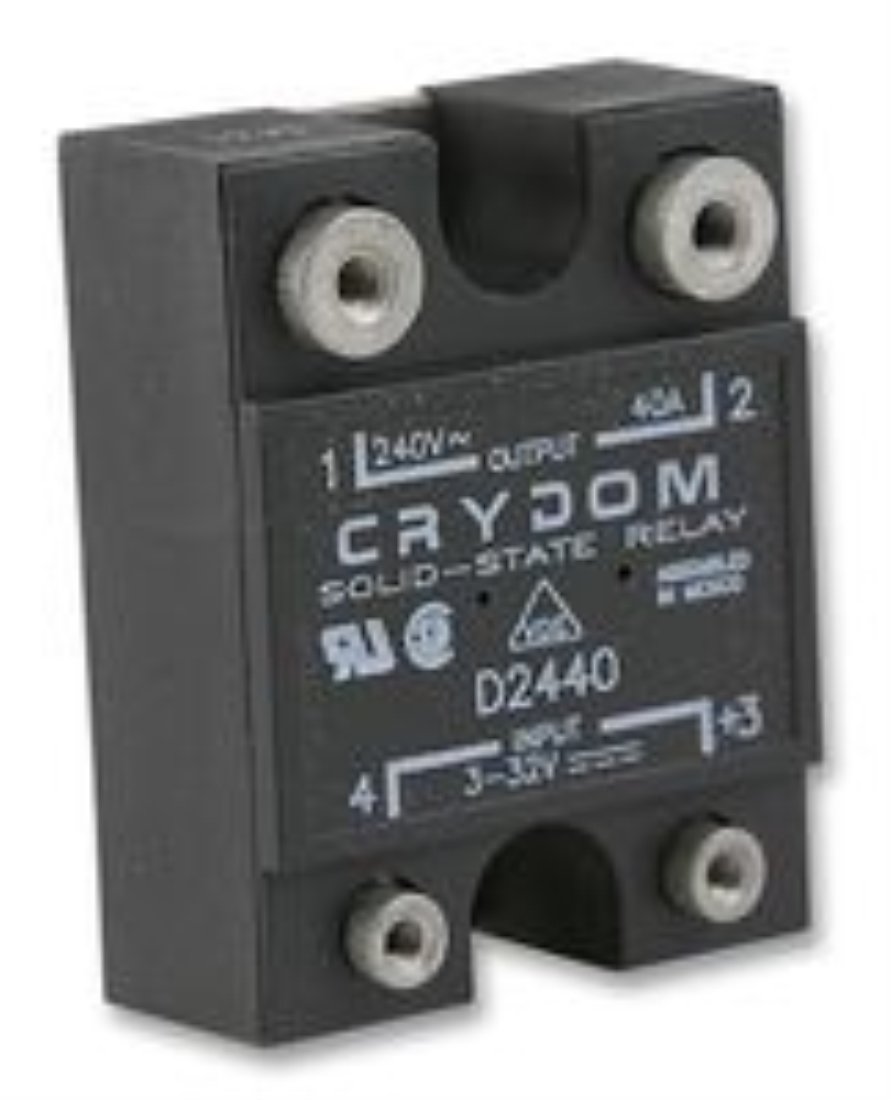
The CRYDOM D2440 is a solid-state relay (SSR) designed for switching AC loads up to 40 A at 240 V, with a control input range of 3–32 V DC. It’s a panel-mount device commonly found in industrial control panels, HVAC systems, and process automation where reliable, silent switching is needed. This review examines its place in real-world applications, its functional characteristics, and where it might fall short.
In practice, the D2440 is often used to control resistive loads like heating elements, or inductive loads such as small motors and solenoids. Its zero-crossing switching (for AC) helps reduce electrical noise and inrush current, making it a good fit for applications where EMI is a concern. The 3–32 V input range accommodates various control signals, from logic-level outputs to 24 V industrial standards, so it interfaces easily with PLCs and microcontrollers.
Key functional features include optical isolation between input and output, which protects sensitive control circuitry from high-voltage transients. The relay is housed in a compact, industry-standard package with screw terminals for secure wiring. It’s rated for 40 A at 240 V AC, but note that this rating assumes proper heatsinking—without a heatsink, the continuous current capacity is significantly lower. The D2440 also has a built-in snubber network to suppress voltage spikes, which is beneficial when switching inductive loads.
One limitation is that SSRs like the D2440 dissipate more heat than electromechanical relays. At full load, the forward voltage drop across the output semiconductors generates heat that must be managed. This means you’ll likely need a heatsink, which adds cost and space. Also, SSRs are typically more expensive than mechanical relays, so for simple, low-cycle applications, a mechanical relay might be more cost-effective. Additionally, the D2440 is not a latching relay; it requires continuous input power to stay on, which can be a drawback in systems where power conservation is critical.
Compared to electromechanical relays (EMRs), the D2440 offers silent operation, no moving contacts to wear out, and faster switching. However, EMRs can handle higher inrush currents and don’t require heatsinking in many cases. For high-cycle applications, the SSR’s longer lifespan justifies the higher cost. Compared to other SSRs, the D2440’s 40 A rating is on the higher end for this form factor, but there are models with higher voltage ratings or integrated heatsinks that might be more convenient.
Who is this for? The D2440 is suitable for engineers and technicians who need a robust, long-life switching solution for AC loads in industrial environments. It’s ideal for applications with frequent switching cycles, such as temperature control in ovens or plastic molding equipment. It’s also a good choice for noisy environments where silent operation is preferred. However, it’s not for hobbyists or beginners due to the need for proper heatsinking and safety precautions when working with mains voltage. Also, if your application requires switching both AC and DC loads, or if you need a normally-closed configuration, this model (which is normally-open) may not fit. Those with very tight budgets or low-power applications might find a mechanical relay or a smaller SSR more appropriate.
In summary, the CRYDOM D2440 is a solid, reliable SSR that does its job well, provided you account for heatsinking and understand its limitations. It’s not a glamorous product, but in the world of industrial control, reliability and predictability matter more than flash.