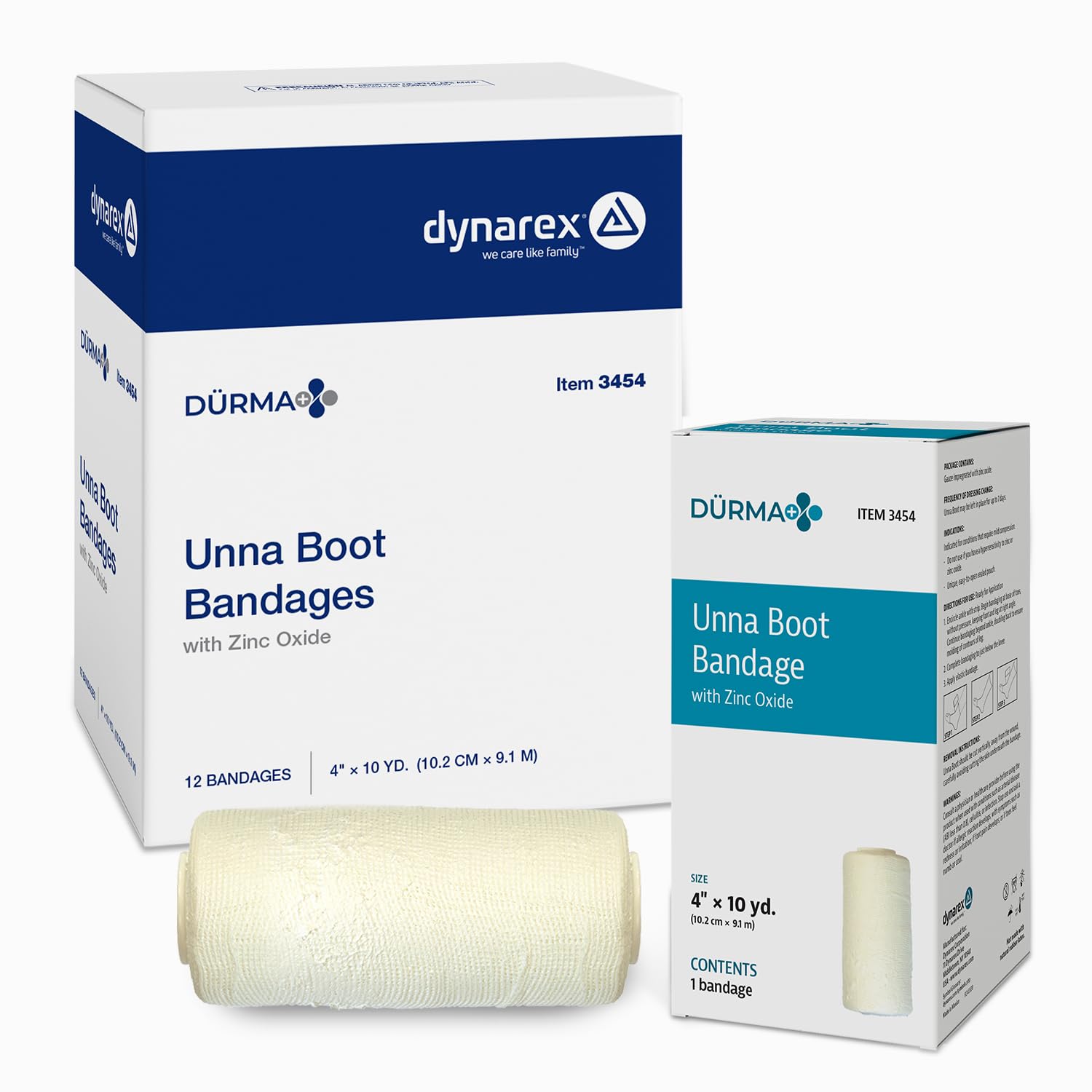
The Dynarex Dürma+ Unna Boot Bandages are a specific type of wound care dressing often seen in clinical settings for managing venous leg ulcers, edema, and certain sprains. At 4 inches by 10 yards, these rolls come in a case of 12, making them a bulk option for regular use. Unlike standard elastic bandages, these are impregnated with zinc oxide and calamine, which changes both how they are applied and what they achieve.
These bandages are designed to maintain a moist wound environment while providing consistent compression. In practice, this means a healthcare professional or trained individual wraps the bandage snugly around the lower leg, starting at the foot and working upward. The zinc oxide helps soothe the skin and reduce irritation, while the calamine offers mild astringent properties. The bandage hardens slightly after application, forming a semi-rigid support that maintains pressure without constant readjustment.
One of the key functional features is the combination of compression and moisture retention. The bandage is not meant to be changed daily; it can stay in place for up to several days, depending on the wound exudate and clinician instructions. This reduces dressing changes and can speed healing for chronic wounds. The compression helps reduce edema by encouraging fluid movement back toward the heart, which is critical for venous insufficiency.
However, there are notable limitations. Applying an Unna boot correctly requires skill—it is not a simple wrap-and-go product. Incorrect application can lead to uneven pressure, skin damage, or ineffective compression. Additionally, the bandage can feel heavy and restrictive once set, and some patients find it uncomfortable, especially in warm weather. The zinc oxide can also cause skin reactions in sensitive individuals, though this is relatively rare.
Compared to standard elastic compression bandages, such as ACE bandages or Coban, the Dynarex Dürma+ offers a more targeted approach for chronic wounds. Elastic bandages are easier to apply and adjust but do not maintain a moist environment or deliver zinc oxide. For acute sprains, an elastic bandage may be more practical because it allows for easier reapplication and monitoring. For chronic edema or non-healing ulcers, the Unna boot is often preferred by clinicians for its sustained compression and wound-healing benefits.
This product is suitable for individuals with venous leg ulcers, stasis dermatitis, or chronic edema under the guidance of a healthcare provider. It is also used for certain post-surgical or post-injury situations where firm, long-lasting compression is needed. It is not suitable for people with arterial insufficiency, severe peripheral neuropathy, or active infections without medical supervision. The application process makes it impractical for self-care unless the patient is trained, which limits its use to clinical settings or home care with professional assistance.
Realistic performance expectations are important. These bandages will not instantly heal a wound or eliminate edema overnight. They work gradually over days to weeks, with regular changes. The zinc oxide does not have strong antimicrobial effects, so wound infection remains a risk. The bandage can also become messy if exudate leaks, and removing it may cause some discomfort if it adheres to the skin.
In summary, the Dynarex Dürma+ Unna Boot Bandages are a specialized tool for specific medical needs. They are not a general-purpose bandage and should not be treated as such. Their effectiveness depends heavily on proper application and patient selection. For clinicians or patients managing chronic lower leg conditions, they offer a proven method of compression and moisture control. For others, simpler alternatives may be more appropriate.