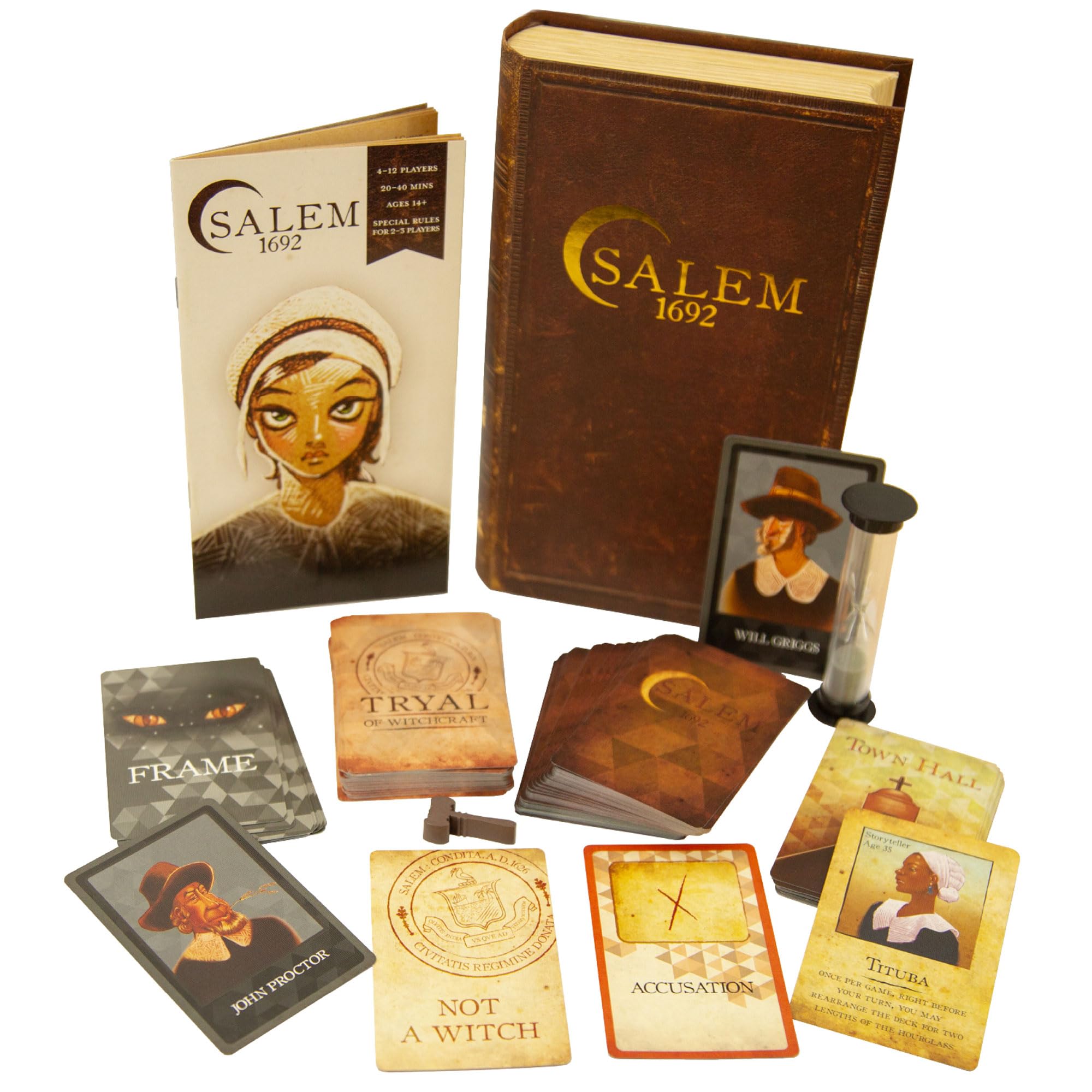
The Facade Dark Cities Series brings us Salem 1692, a card game that leans heavily into social deduction and deceit. It’s set during the historical witch trials, but don’t expect a history lesson—this is more about accusations, hidden roles, and trying to avoid being hanged. Over several rounds, players are secretly assigned as either a witch or a citizen, and the goal is to identify and eliminate the opposing faction before your own side gets wiped out. The game supports 4 to 8 players, making it a solid choice for larger gatherings where bluffing and reading people are key.
In practice, Salem 1692 plays out like a faster, more chaotic cousin to games like The Resistance or Werewolf. Each round, players take turns accusing someone of witchcraft, and a vote determines who gets put on trial. The accused then draws a fate card, which can result in hanging, exoneration, or unexpected twists like a pardon. This element of luck—via the fate cards—is where the game diverges from pure deduction. You can be absolutely certain someone is a witch, but if the card says they’re innocent, they walk free. This randomness can feel frustrating if you’re a strategist who prefers logic over chance, but it also keeps the tension high because no accusation is a sure thing.
A key feature is the role distribution and the limited information each player has. Only the witches know each other; citizens are in the dark. This creates a classic dynamic of paranoia and false accusations. The game also includes special role cards (like the Judge or the Priest) that add extra abilities, such as looking at a player’s role card or influencing the vote. These abilities help mitigate some of the luck, but they don’t eliminate it entirely. One trade-off is that the game can feel unbalanced with certain player counts—at 4 players, it’s often too easy to deduce roles, while at 8, the chaos can make it hard to track who said what.
Compared to more structured deduction games like Mafia or Secret Hitler, Salem 1692 is lighter and more reliant on luck. That’s not necessarily a bad thing—it makes it more accessible for casual groups who don’t want to memorize complex rules or keep track of intricate voting patterns. However, if your group prefers games where skill and logic consistently determine the outcome, the fate cards might feel like a cop-out. It’s also worth noting that the game can end abruptly if a witch gets lucky with a fate card, which might leave some players feeling cheated rather than outplayed.
Who is this for? It’s best suited for teens and adults who enjoy bluffing games with a party atmosphere. Families with older kids (12+) will find it engaging, especially if they like the theme of witch hunts. It’s not ideal for players who dislike social deduction or who get frustrated by random elements. Also, if your group struggles with confrontation or false accusations (which are central to the game), this might create awkwardness rather than fun.
On the downside, the components are average—the cards are sturdy enough, but the box is a bit flimsy for frequent travel. The art style is dark and thematic, which fits the setting but might not appeal to everyone. There’s also a learning curve for the special roles; the rulebook could be clearer, especially for first-time players. A few rounds of play usually clear things up, but expect some initial confusion.
Overall, Salem 1692 is a decent addition to the social deduction genre. It doesn’t reinvent the wheel, but it offers a quicker, luck-driven alternative to heavier games. If you have a group that enjoys bluffing and doesn’t mind a little chaos, it’s worth a try. Just don’t expect it to replace your go-to deduction game if you prefer pure strategy.