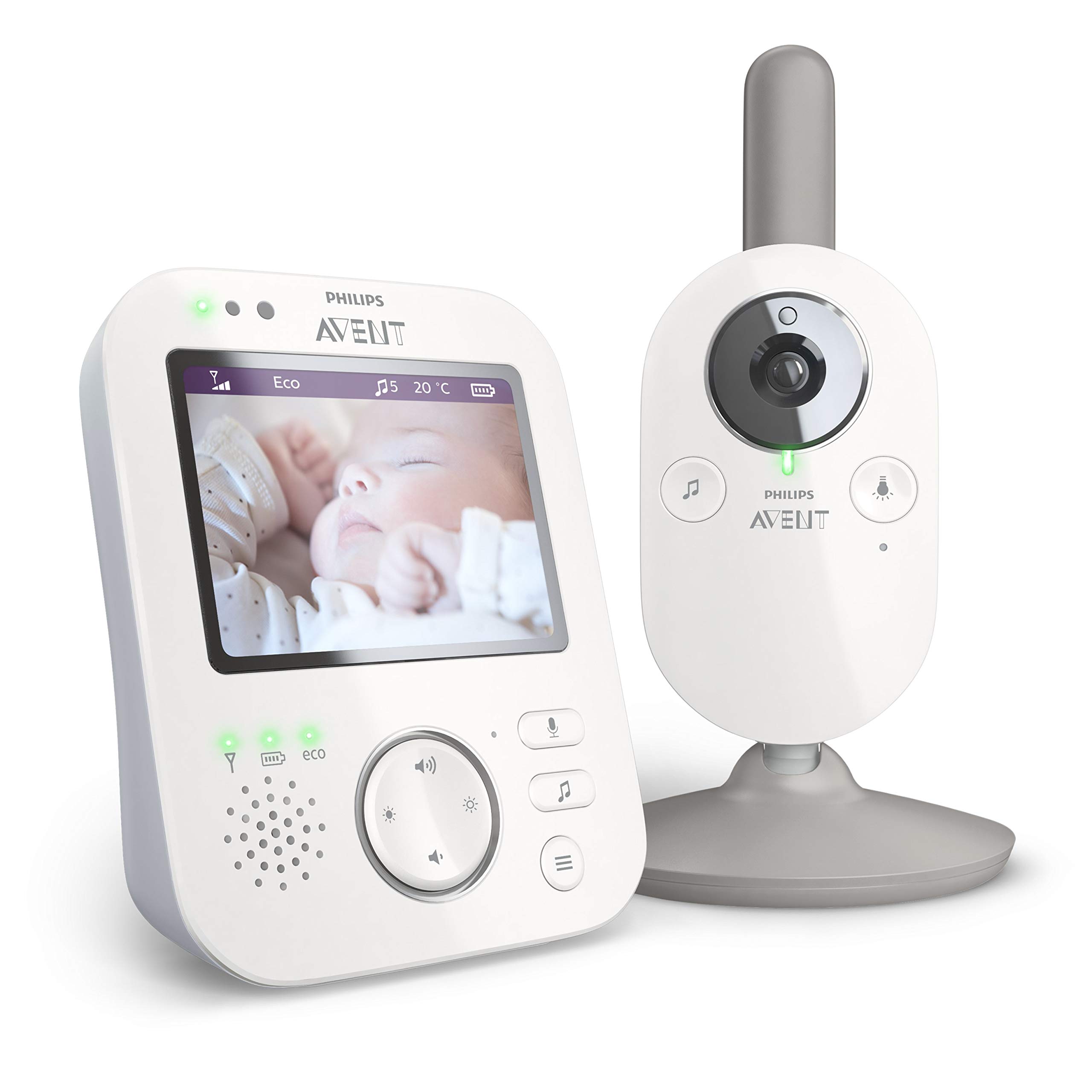
The PHILIPS Avent Digital Baby Monitor with a 3.5-inch display is a straightforward video monitor that skips Wi-Fi for a dedicated connection. In everyday use, it serves as a tool for parents who want to check on their baby without pulling out a smartphone or dealing with app notifications. The monitor’s 2.4 GHz frequency promises a 980-foot range, which in practice works well for most homes, though walls and floors can reduce that distance. The 3.5-inch screen is small but clear enough to see if a baby is sleeping or stirring, even in low light thanks to the infrared night vision.
Key functional features include two-way talk, a temperature sensor, and a selection of lullabies. The two-way talk allows a parent to soothe a baby from another room, and the audio quality is decent—not studio-grade, but sufficient for calming a child. The temperature sensor displays the room temperature on the parent unit, which is handy for ensuring the nursery is not too hot or cold. The lullabies are basic and can be played from the parent unit, but the selection is limited and the sound quality is average.
A notable limitation is the lack of Wi-Fi connectivity. This is a trade-off: the monitor offers a secure, interference-free connection without the risk of hacking, but it also means no ability to view the feed remotely from a phone or tablet. For parents who want to check on the baby while at work or out for the evening, this monitor will not work. The range is also somewhat optimistic; in practice, with multiple walls, the signal can drop closer to 400-500 feet, which is still reasonable for many homes but not as advertised.
Compared to a general Wi-Fi baby monitor, such as those from brands like Nanit or Motorola, this PHILIPS Avent model is simpler and more privacy-focused. Wi-Fi monitors often offer higher-resolution video, cloud storage, and smartphone access, but they require a stable internet connection and can be vulnerable to security issues. The PHILIPS Avent, on the other hand, is a closed system: no app, no internet, just a direct feed. This makes it more reliable for real-time monitoring at home, but less versatile for remote viewing.
Who is this monitor for? It suits parents who prefer a dedicated, no-fuss device for in-home use, especially those concerned about privacy or who find smartphone notifications distracting. It works well for night-time checks and during naps when the parent is in another room. It is not suitable for parents who need to monitor from a distance, such as when the baby is with a caregiver or during travel, because the monitor stays at home. It also may not appeal to those who want high-resolution video or advanced features like sleep tracking or motion alerts.
In terms of build quality, the monitor feels sturdy, and the parent unit has a decent battery life for a few hours of portable use, though it is best kept plugged in for continuous monitoring. The camera unit has a simple stand and can be wall-mounted, but the mount is not included. The setup is straightforward: plug in the camera, turn on the parent unit, and they pair automatically. There is no complex configuration, which is a plus for less tech-savvy users.
Overall, the PHILIPS Avent Digital Baby Monitor delivers on its core promise of a reliable video feed without Wi-Fi. It is not flashy or packed with extras, but it performs consistently for its intended use. The limitations—small screen, no remote access, average lullabies—are clear trade-offs for the simplicity and security. For parents who value those trade-offs, it is a solid choice.