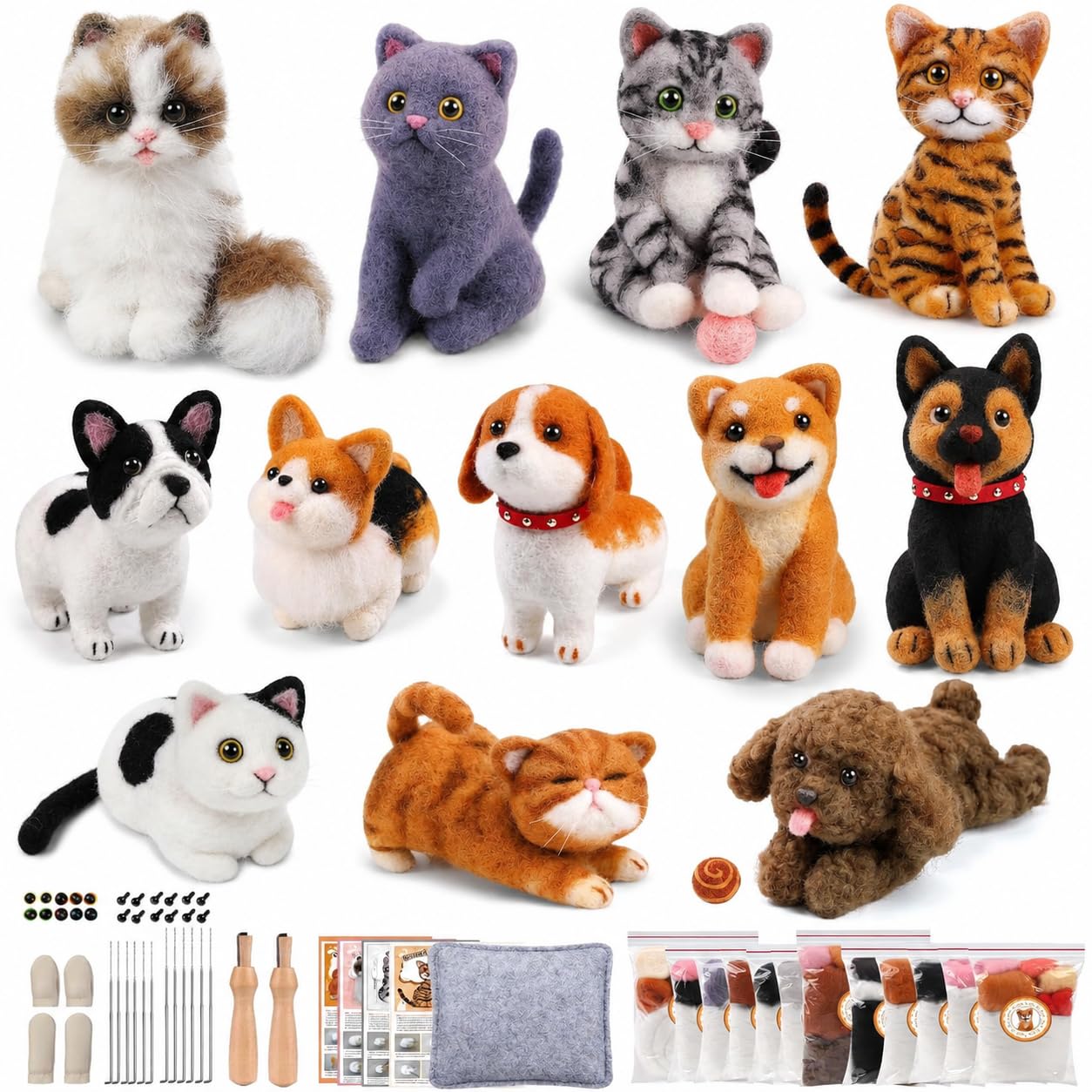
Needle felting has a low barrier to entry compared with most fiber crafts. A foam pad, a few barbed needles, and some wool roving are enough to start stabbing loose fibers into solid shapes. The Mayboos 12-piece kit bundles those basics together for people who want to try the craft without assembling supplies piece by piece. It is aimed at beginners making small animal figures, and that framing is worth keeping in mind when judging what the kit actually delivers.
In practice, a kit like this gets used at a kitchen table over a few evenings. You lay the foam pad down, pull off a tuft of roving, and work it against the pad with a needle until it holds a shape. Small animals are a common first project because the forms are compact and forgiving: a round body, a smaller head, ears, and maybe a tail. The Mayboos set includes the tools for that kind of work, but the wool quantity and color range determine how far it goes, and that is where expectations should be calibrated.
What the kit includes is a collection of felting needles, a foam working pad, and wool roving in assorted colors. The needles are the core of any felting setup. They are barbed along the shaft, and repeated stabbing entangles the fibers. Beginner sets usually mix needle gauges: coarser needles for building volume and finer ones for surface detail. The 12-piece count covers the tools and materials together rather than twelve of any single item, so buyers should read the listing carefully rather than assume a large stock of needles.
The foam pad is the unsung component. Needles dull quickly and snap if they hit a hard surface, so the pad absorbs the stabs and protects both the needle and the table. Foam pads are consumables; they compress and develop a worn center over time. A pad included in an inexpensive kit is typically thin, and users working regularly will likely replace it with a denser block sooner than they expect. That is a normal trade-off at this price point, not a defect, but it is worth knowing before starting.
The wool is the other variable. Small kits tend to include modest amounts of roving, enough for one or two palm-sized figures rather than a series of projects. Color selection matters for animal work, where a few neutrals plus a couple of accent shades cover most designs. If the included palette skews bright or limited, beginners may find themselves buying additional roving to finish a specific animal. Checking the listed colors against an intended project is a sensible step.
Compared with buying components separately, a bundled kit trades flexibility for convenience. A craft-store purchase of a dense foam block, a multi-pack of needles in several gauges, and a few ounces of roving will cost more upfront but gives control over quality and quantity. The Mayboos kit suits someone who wants to test whether they enjoy the rhythm of felting before investing further. It is also reasonable for a gift or a one-off weekend project. It is less suitable for someone planning to felt regularly or produce larger pieces, who will outgrow the wool and pad quickly.
Handling needs a mention. Felting needles are sharp, and the barbed tips catch skin easily. The kit does not change that reality, and beginners should expect a few pricks while learning to keep fingers clear of the stabbing zone. Working slowly and keeping the project on the pad reduces the risk. The needles themselves are thin and can bend or break with sideways pressure, so straight up-and-down motion matters. Spare needles are useful to have on hand, which is a point in favor of sets that include several.
Realistic expectations for finished results are modest. A first animal figure will look lumpy and uneven; that is the nature of learning the technique, not a reflection of the kit. The tools are simple and the outcome depends mostly on practice and patience. The kit provides a starting point, and the included materials are adequate for that purpose, though not generous.
In short, the Mayboos 12-piece kit is a low-cost entry into needle felting with the core supplies for small animal projects. It fits curious beginners, gift-givers, and casual crafters working on a single figure. It does not fit experienced felters, anyone planning larger or repeated projects, or buyers expecting a full-color wool supply. Treat the pad and wool as starter quantities, plan for replacements, and the kit does what a beginner set should: it lets you find out whether you like the craft before spending more.